Minsk The day after we arrived in Minsk, we took in a walking tour of the center of town that lasted 2 hours. We learned a lot about Minsk - it's history and the its citizens. Here's what we learned: Minsk (pop. ~ 2 million) is derived from an old river name, Měn. The Belarusian pronunciation sounds like Miensk and with Russian influence, became Minsk. Historians mark the founding of Minsk in 1067. Over the centuries, the area was controlled by Sweden, Poland, Russia (more than once) and the Grand Duchy of Lithuania. The borders changed in shape and size many times. WWII brought German occupation in 1941. At the time, Minsk had a significant Jewish population (48%). On March 2, 1942, approximately 5,000 Jews were rounded up and shot. There is a memorial erected in the area of the Jewish ghetto where this happened and is called "The Pit". Today, the Jewish population in Minsk is less than 1%. The city is one of the cleanest in all of Europe. Everyone that can work has a job, and many are out each day sweeping and cleaning. Although the economy in Belarus is not very robust, there are many venues for art and culture. In 1944, Minsk was recaptured by Soviet troops after heavy fighting. Much of the town center was reduced to rubble. By years end, the population was down to only 50,000. Rather than engage in reconstruction, Stalin rebuilt Minsk with his preferred style of architecture of grand buildings, broad avenues and wide squares. Consequently, much of the original and traditional look of Minsk no longer exists - all replaced with modern structures. This is in contrast to many other Baltic countries who have tried to leave the "old look" intact. In the center of Minsk, the river Свислочь (Svislach) meanders around and forms a bit of a lake. In the lake is a man-made island called the "Isle of Tears". On the island is a memorial to the 700 Belarusian troops who died in the 9-year conflict involving Soviet forces in Afghanistan (the "Forgotten War"). There is a chapel with statues of mothers, wives and sisters, all weeping and sorrowing at the loss of sons, husbands and brothers. The veterans of this war have not been treated well. This is still a sore spot for Belarusians, who did not want to be involved with the conflict.
Among these figures is a violinist, a pregnant woman and children - a representation of all walks of life that were killed here.
"To the shining memory to the bright days of 5,000 Jews who perished at the hands of sworn enemies of humanity, German-fascist butchers, March 2, 1942"
Panoramic view
Art Nouveau styling on older buildings
Towers used to disrupt "Voice of America" broadcasts in the 60's and 70's
Apartment of Lee Harvey Oswald
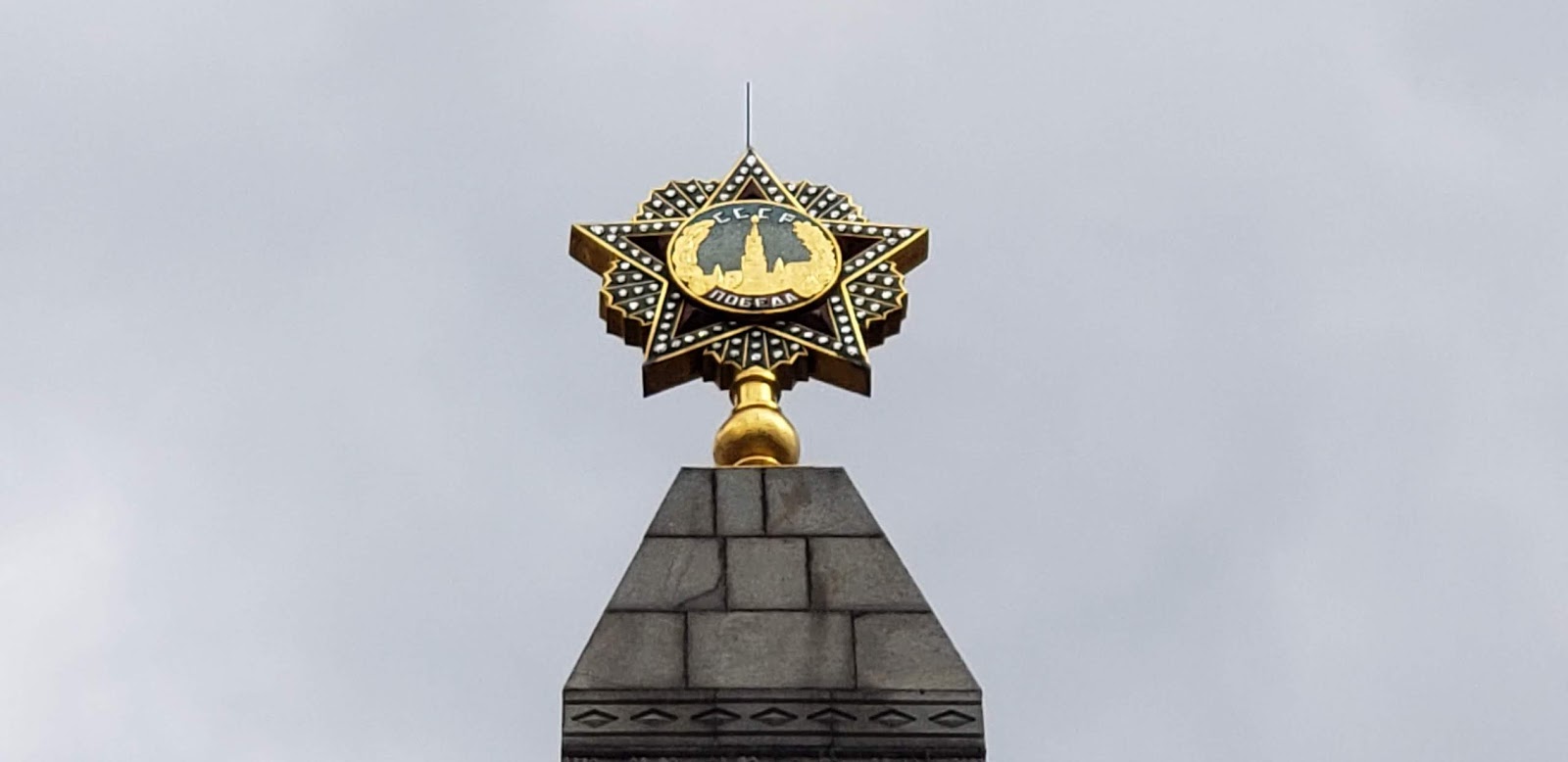
Victory Monument to honor those who died fighting against German fascist invaders
Brest The city of Brest is situated in the southwest corner of modern day Belarus and shares a border with Poland. In 1833, the construction of a fortress began at the outskirts of Brest, where the Bug and Mukhavets Rivers converge and along the border with Poland. On September 1, 1939, one week after signing the Molotov-Ribbentrop Pact (for info on this agreement, click here), Germany invaded Poland (this was known as The September Campaign). As a consequence of that invasion, the fortress at Brest (a part of Poland then) was also attacked. The battle (known as the Battle of Brest-Litovsk) went on for three days before falling into the hands of the German Army with heavy casualties on both sides. This part of Poland was part of the Soviets slice of the aforementioned Molotov-Ribbentrop Pact and eventually was turned over to the Red Army. In 1941, Operation Barbarossa, a plan by Nazi Germany to invade and conquer the western Soviet Union was underway. Brest was a strategic part of the plan. Without warning, German forces attacked the fortress at Brest (now occupied by Red forces) and engaged in a battle that lasted for eight days. German forces were expecting an easy victory, but the determination and patriotism of the defenders became a symbol of Soviet Resistance and the fortress was subsequently named a Hero Fortress to coincide with the same moniker for Brest as a Hero City. In 1945, at the end of WWII, the Byelorussian SSR, the area now known as Belarus, became a founding member of the United Nations. In 1990, the republic declared sovereignty. After the break up of the Soviet Union, Belarus declared its independence in September, 1991.
Front entrance to the Fortress of Brest
This monument is called "Thirst". A thirst for water but also for freedom.
High school students, since 1972, hold vigil on the eternal flame of honor and the guard is changed every 20 minutes.
The military detail marching back after the changing of the guard
In 1985, five European countries signed an agreement to abolish border controls between their respective countries. Since then, 21 additional countries have signed what is called the Schengen Agreement. One of the stipulations, at least in Estonia, is that people from certain nations can enter the country and stay for 90 days without a visa. On the 15th of April, our 90 days expired. So to prevent any imperial entanglements, the Area office has moved us to Minsk, in Belarus, until our residency cards are ready to be issued to us. So, here we are in the Orbita Hotel for a couple of weeks vacation. Actually, the work is much harder when you have no assignments. We are getting cabin fever. Fortunately, Belarus is part of our mission and there are "volunteers" who are assigned here and they have been helping us feel right at home. We are learning to use the subway and finding our way around. We took a city tour and learned quite a bit about Minsk. That tour will be in a future post that I will post once I return to Estonia (we have certain restrictions here). Today we went to Brest. It is located near the border with Poland. If you know your WWII history, you will understand what happened here in 1939 and again in 1941. More on that in a future post. We love learning about this place, but really do miss our missionaries, and a few other things back in Estonia. Here are a few pictures.
It was terribly cold and windy that day.
Heber C. Kimball and Bro. Brigham?
Palace of Culture
Closeup of the relief
Russian Orthodox Church
Icons on the Orthodox Church
I snuck this pic of the Orthodox priest walking by
Once or twice a year, the patriarch (an emeritus status General Authority from Salt Lake) assigned to the Europe East Area, will come through the Baltics and give blessings to those who have requested one. If there are senior couples in the country, they are usually tasked with getting things ready for the visit by setting a "homey and comfortable" atmosphere in whatever place the blessings will be given. In our case, since our chapel is under renovation, our only option was to use the rented room (called the Teaching Center) that is used by Seminary/Institute and the missionaries. It's just a single room with tables and chairs. There's not much else to work with. We noticed that the room had not been cleaned since before the winter weather and the floor really needed to be swept and mopped. So we set out to clean this room and make it a nice place. We bought a carpet and flowers and straightened everything in the room to make it nice. Here is a picture of the result with a time-lapse video of our cleaning to get the final result.
At the Zoo We had a free afternoon and invited a friend to join us at the zoo. Here are a few pictures from that excursion. Our friend was very knowledgeable about many of the animals and it made our tour more interesting. Most of the animals are from Asia and Europe - many that we've never seen before. It's not as modern as what we are used to, but the price of admission was very affordable.
It was the summer of 1940. A dark chapter in Estonian history began in earnest. A year earlier, the infamous Molotov-Ribbentrop pact had been signed between Nazi Germany and the Soviet Union. It was promoted as a non-aggression agreement, but there was a secret protocol that divided up the territories of Romania, Poland, Lithuania, Latvia, Estonia and Finland into Nazi and Soviet spheres of influence. Less than a month after the pact was signed, Germany invaded Poland and thus started a domino effect where subsequently all of these countries were annexed. During Stalin's "Reign of Terror", the Soviet Union deported over 30,000 people from Estonia to Siberia. They were mostly women and children. Anyone connected with politics, government, military or other persons of influence were summarily rounded up with little or no warning and given only a few minutes to pack a suitcase and then shipped in boxcars across the vast stretches of Russia. Many others were imprisoned in jails where torture and neglect were a daily routine. For many, their lands and property were confiscated and never returned to them. It is estimated that Estonia lost over 17.5 % of its population during the purge. In the late 1950s, they were allowed to return home. Many never returned, having died in captivity. On March 25th every year, the memory of these lost loved ones is commemorated with a candlelit display at the Vabaduse väljak (Freedom Square) in the center of Tallinn. We viewed the display with a feeling of reverence. In the background we could hear a recording of some very sad-sounding music - a crying cello. People talked in hushed tones. I am humbled to live among these noble and precious people. It is amazing to me that so many people from the "Land of the Free" think that socialism/communism is the way to go. If we do not study history, we are bound to repeat it.
The pattern is in the shape the country of Estonia
Tuesday, March 26, 2019
Oh, the places you'll go! . . . Dr. Seuss
The Alexander Nevsky Cathedralis an orthodox cathedral in the Tallinn Old Town, Estonia. It was built in a typical Russian Revival style between 1894 and 1900, during the period when the country was part of the Russian Empire. It is dedicated to Saint Alexander Nevsky who in 1242 won the Battle on the iceon Lake Peipus, in the territorial waters of present-day Estonia.
In a future post, I will show you the inside of this magnificent and historical edifice.
Want fresh squeezed orange juice? Many stores here have a solution. Just pick a plastic bottle, turn on the machine, and watch it squeeze the juice out of the oranges, right in front of you. Fresh fruits and vegetables are highly prized in Estonia. The less processing of the food, the better.
This is a memorial to those who were engaged in battle during WWII. Each pillar is dedicated to the 15 counties or parishes of Estonia.
This giant sword commemorates the St. George uprising in 1343 when Estonians attempted to drive out all the Danish and German rulers and landlords. The initial skirmish was successful, but an invasion by the Teutonic Order succeeded in squashing the rebellion. In 1346, the Duchy of Estonia was sold to the The Teutonic Order for 19,000 köln marks by the king of Denmark.
St. George Uprising in 1343
Some of the things we get to participate in are activities that can bring a little bit of home for the young missionaries who are, for the most part, living away from home the first time. Here is Sister Dean celebrating her 20th birthday. She accomplished her task of blowing out a single candle in a tub of ice cream in a most splendid manner.
On Sunday, we had the annual Tallinn Branch conference. Afterwards, a group photo was taken. Quite a few people were missing. We normally have a few more than this attending. We love these people so much.
In almost every foreign mission in the world, we can find traces of America. Here, nestled between the two towers of the main gate to Old Town, you can see, in subdued colors, the widely known golden arches of McDonald's: Old World meets New World.
Why wouldn't we see some Americans enjoying a taste of Americana?
Every once in awhile, on a preparation day . . .
Actually in this picture, besides the Americans, there is a Ukrainian, a Brazilian and a South African. Have I mentioned that I love my job?